In short
- Treatment usually takes one to two years, sometimes less or up to three.
- You come back about once a month so the dentist can adjust the wire.
- Types: metal, ceramic (tooth-coloured) and self-ligating (built-in clips).
- A retainer afterwards is part of the treatment, not an extra step to skip.
- Price depends on the type, how complex your teeth are, and whether X-rays, extractions and retainers are included.
Are braces right for me?
Braces help if your teeth are crowded, have gaps, stick out, or your top and bottom teeth don’t meet well. In Nepali many people say “बाङ्गोटिङ्गो दाँत” (crooked teeth) or “खप्टिएर” (overlapping). They are most often fitted in the teenage years, but adults can have them too (Onlinekhabar).
They may not be the right first step if:
- you have gum disease or tooth decay that needs treating first;
- you can’t come back about once a month for a year or more;
- you want a change before an event in a few weeks. Straightening takes time. Whitening or bonding may suit a near date better.
If you want something less visible, read about clear aligners, or compare both on our teeth straightening page. A dentist needs to examine you to know for sure which option fits your teeth.
What happens, step by step
-
Consultation and records. The dentist checks your teeth, gums and bite, takes X-rays (often a full-mouth OPG, sometimes a side-view skull X-ray called a ceph) and photos or moulds. You get a plan, a time estimate and a written price.
-
Getting ready. Any decay is filled and your teeth are cleaned. Some crowded mouths need one or more teeth taken out to make space. Your dentist will explain why if this applies to you.
-
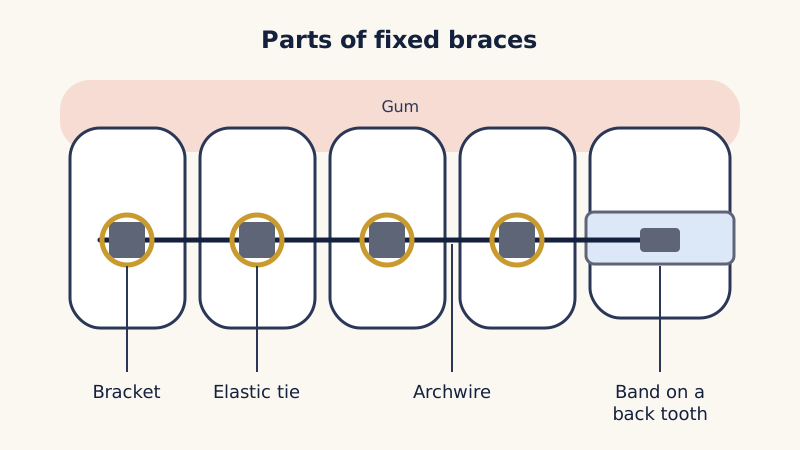
Fitting. Brackets are glued to each tooth and the wire is placed. Gluing and fitting take about 10 to 20 minutes of the visit (Onlinekhabar).
-
Adjustments. You come back about once a month in Kathmandu practice so the dentist can change or tighten the wire (Onlinekhabar). The NHS gives every 6 to 8 weeks (NHS).
-
Taking them off. Most people wear them for 1 to 2 years (NHS). Some finish in under 12 months and some need up to 3 years (Cleveland Clinic).
-
Retainer. On the day they come off, or soon after, you get a retainer to hold your teeth in their new place.
Metal, ceramic or self-ligating?
All three work the same way: brackets plus a wire. The difference is how they look, how strong they are and how the wire is held in place (Cleveland Clinic).
Metal brackets are small steel brackets with elastic ties. They are the most common and the lowest in price.
- Easy to see when you smile.
- Stronger than ceramic brackets.
- A good choice if cost matters most, or for teenagers in sport or school.
Ceramic brackets are tooth-coloured, so they show less in photos and at work.
- More fragile than metal, so take extra care with hard food.
- Cost more than metal in Kathmandu.
Self-ligating brackets have a small built-in clip or door that holds the wire, instead of elastic ties.
- No elastic ties around the brackets.
- Usually metal, sometimes clear.
- Cost the most of the three in published Kathmandu prices. Ask what difference they would make for your teeth.
Retainers after braces
Your teeth can drift back after treatment, so a retainer is part of the treatment (NHS). There are two main kinds:
- Removable retainers: clear plastic trays or a wire-and-plastic plate you take out to eat and clean.
- Fixed (bonded) retainers: a thin wire glued behind the front teeth.
A 2023 Cochrane review found no type of retainer is clearly better than another. Clear plastic ones felt more comfortable but broke more often than wire-and-plastic ones (Cochrane). Your dentist will tell you how long to wear yours and at what times of day.
What’s included, and what may cost extra
Ask for a written list before you start. In Kathmandu, these are often priced separately:
| Usually in the price | Often extra (ask) |
|---|---|
| Brackets, wires and ties | X-rays: OPG and ceph |
| Fitting visit | Cleaning before braces |
| Monthly adjustments | Fillings or extractions to make space |
| Taking the braces off | Retainers |
| Replacing broken brackets more than once |
How much braces cost in Kathmandu
Published Kathmandu clinic prices for metal braces ranged from NPR 30,000 to 95,000 in October 2026, with most between NPR 60,000 and 80,000. Ceramic braces ranged from NPR 60,000 to 120,000, and self-ligating from NPR 100,000 to 140,000. These are full-treatment prices taken from clinic websites; most pages were not dated.
What changes the price:
- Type of braces: metal, ceramic or self-ligating.
- How complex your teeth are: mild crowding takes less time than a bite problem.
- Extraction or non-extraction treatment.
- What’s included: X-rays, retainers and cleaning.
- How long treatment takes, because each month is a visit.
| Treatment | Our price (NPR) | Typical visits |
|---|---|---|
| Braces | NPR 60,000 to 80,000 metal braces, full treatment | Monthly |
See all our prices on the price list.
Risks, recovery and aftercare
Fixed appliances are safe for most people, but they take care (NHS, Cleveland Clinic):
- Soreness: teeth feel sore for a few days after fitting and after each adjustment. The first hours are often the worst.
- Rubbing: brackets can rub the inside of your lips and cheeks at first. Soft wax over the bracket helps.
- Cleaning: food gets trapped around brackets. Brush after meals and use a small interdental brush every day. Book cleanings as advised.
- Food: avoid hard and sticky food, chewing gum, bones and nuts. Cut fruit into small pieces.
- Broken parts: a loose bracket or poking wire is not an emergency, but call so it can be fixed at your next visit or sooner.
Get urgent care if
- you have pain that painkillers don't help;
- you hurt your mouth or face in a fall or accident;
- your gums bleed a lot, swell, or show signs of infection;
- a broken wire is cutting your cheek and you can't cover it with wax.
Check who is treating you. In 2024 the Nepal Medical Council warned about treatment by a health worker posing as a dentist. It advised patients to check the NMC number of any dentist before starting (The Kathmandu Post). Only a dentist on the NMC Specialist Register for orthodontics may use the title “orthodontist”. See our dentists to know who will treat you.
Alternatives
| Option | How it works | Time | Upkeep | Best for |
|---|---|---|---|---|
| Fixed braces | Brackets and wire, fixed on | 1 to 2 years | Monthly visits; careful cleaning | Most crowding, gaps and bite problems |
| Clear aligners | Removable clear trays | Often similar; depends on the case | Wear 20 to 22 hours a day | Mild to moderate crowding or gaps; adults who want discreet treatment |
| Bonding or veneers | Changes the shape of front teeth; doesn’t move them | 1 to 3 visits | Polish and check-ups | Small gaps or chips when the bite is fine |
| No treatment | Keep your teeth as they are | None | Normal check-ups | Mild crowding that doesn’t bother you |
Not sure? Compare both on the teeth straightening page.
The dentists who do this treatment

Clean and safe
Read how we clean and sterilise instruments on our sterilisation and safety page. If you feel nervous about dental visits, see help for nervous patients.
Sources
- Orthodontics (braces), NHS (2026)
- Braces: types and how they work, Cleveland Clinic (2023)
- Retention procedures for stabilising tooth position after treatment with orthodontic braces, Cochrane (2023)
- Braces fitting and types (Nepali), Onlinekhabar (2020)
- Dental treatment costs and follow-up in Nepal (Nepali), Onlinekhabar (2023)
- Want orthodontist treatment? Beware of dental quackery, The Kathmandu Post (2024)
This page is general information, not a diagnosis. A dentist needs to examine you to know what is right for your teeth.