In short
- Removal is advised for wisdom teeth with disease, not for healthy ones just in case.
- Usually a few minutes and no more than 40 minutes, under local anaesthetic. Home the same day.
- Most people are back to normal the next day. Pain and swelling can last up to 2 weeks.
- Published Kathmandu prices for surgical removal were NPR 5,000 to 18,000 per tooth in October 2026.
Is wisdom tooth removal right for me?
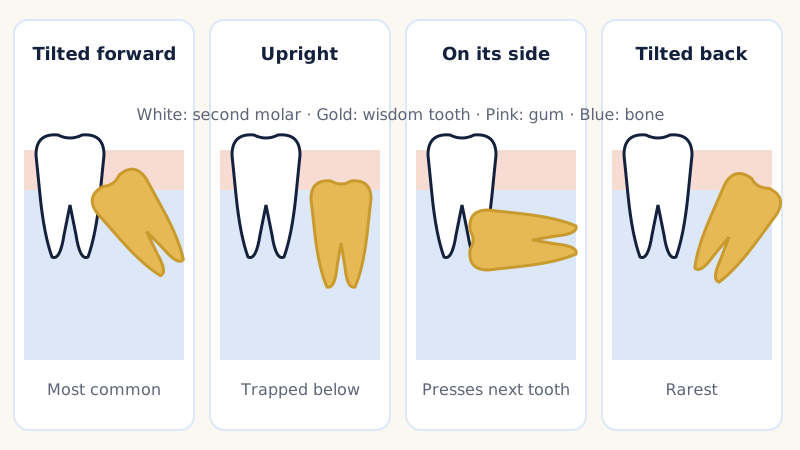
Wisdom teeth are the last teeth at the back of the mouth. Some come through fine. Others get stuck (impacted) under the gum or bone.
Removal helps when a wisdom tooth has disease. NICE lists reasons such as decay that cannot be repaired, infection of the gum around it, an abscess, a cyst, or damage to the tooth next to it. Signs can include pain or swelling in the jaw, red or bleeding gums, a bad taste, bad breath, or trouble opening your mouth (Cleveland Clinic).
Who it isn’t for: people with healthy wisdom teeth that cause no trouble. NICE advises against removing them just in case. A Cochrane review (2020) found too little evidence to say removal or keeping them is better, so the choice is shared with your dentist, with regular checks if you keep them.
A dentist needs to examine you, with an X-ray, to know for sure.
What happens, step by step
This is the typical process. Our dentists confirm the plan after checking you.
- Check and X-ray. The X-ray shows the angle of the tooth and its roots.
- Numbing. Local anaesthetic numbs the area. Sedation may be possible for harder cases or very anxious patients, with written consent.
- Removal. The dentist may make a small cut in the gum, or take the tooth out in pieces. You feel pressure, not sharp pain.
- Stitches and gauze. Dissolvable stitches may be used. You bite on gauze to stop the bleeding.
- Home the same day, with aftercare advice and a check-up visit if needed.
Removal usually takes a few minutes, and no more than 40 minutes (NHS).
If the wisdom tooth has come through the gum, it can often be taken out much like any other tooth. See tooth extraction.
If the tooth is stuck, the dentist usually opens the gum, may remove a little bone, and may take the tooth out in pieces. A tooth covered only by gum is usually simpler than one still covered by bone (Cleveland Clinic). Recovery may take a little longer.
What’s included, and what may cost extra
| Usually part of the removal | May cost extra |
|---|---|
| Local anaesthetic | X-ray (a full-mouth OPG is often charged separately) |
| Removing the tooth | Sedation, if offered and needed |
| Stitches and gauze | Each additional wisdom tooth |
| Aftercare advice |
How much wisdom tooth removal costs in Kathmandu
Published Kathmandu clinic prices for surgical or impacted wisdom tooth removal ranged from NPR 5,000 to 18,000 per tooth in October 2026, typically NPR 8,000 to 15,000. One clinic listed a non-surgical wisdom tooth removal at NPR 6,000. A full-mouth X-ray (OPG) was usually NPR 1,000 to 2,000.
What changes the price:
- How stuck the tooth is. Tilted, sideways and bone-covered teeth take longer.
- How many teeth come out.
- X-rays and sedation.
| Treatment | Our price (NPR) | Typical visits |
|---|---|---|
| Wisdom tooth removal | NPR 8,000 to 15,000 per tooth, surgical | 1 plus a check |
See our full price list.
Risks, recovery and aftercare
Most people are back to normal the next day. You may need 1 to 3 days off after a hard removal. Pain and swelling can last up to 2 weeks, and usually ease after a day or two (NHS, reviewed June 2024).
Aftercare:
- If it bleeds, press clean, rolled-up gauze on the socket and bite firmly for at least 10 minutes.
- Eat soft food and chew on the other side.
- Do not smoke or drink alcohol while it heals.
- Do not drive for 24 hours after sedation.
- Take paracetamol or ibuprofen for soreness, following the packet.
Possible problems: dry socket (the blood clot is lost and the socket becomes very painful), infection, and nerve damage that leaves the tongue, lip or chin numb or tingly. Nerve numbness usually improves, but it can last weeks or months (NHS).
Get urgent care if
- Bleeding does not stop after pressing for 10 minutes. Call us. If heavy bleeding will not stop, go to a hospital emergency department.
- Pain gets worse instead of better, or you get a fever. Call us.
- Swelling spreads to your eye or neck, or you find it hard to breathe or swallow. Go to a hospital emergency department.
More first-aid steps are on our emergency dentist page.
Alternatives
| Option | How it works | Time | Upkeep | Best for |
|---|---|---|---|---|
| Keep and check | The tooth stays; a dentist checks it and takes X-rays when needed | Check-ups | Careful brushing at the back | Healthy wisdom teeth with no problems |
| Simple extraction | The tooth is lifted out in one piece | 1 short visit | Normal healing | A wisdom tooth that has come through |
| Surgical removal | The gum is opened and the tooth may be removed in pieces | 1 visit plus a check | Up to 2 weeks of healing | A stuck tooth with disease |
The dentists who do this treatment

Clean and safe
Wisdom tooth removal leaves an open wound, so clean, sterilised instruments matter. Read how we clean and sterilise. If you feel nervous, our nervous patients page explains how we can go slowly.
Sources
- Wisdom tooth removal, NHS (2024-06-12)
- Guidance on the extraction of wisdom teeth (TA1), NICE (2000)
- Surgical removal versus retention of asymptomatic impacted wisdom teeth, Cochrane (2020)
- Impacted wisdom teeth, Cleveland Clinic (2022-01-21)
- How to find an emergency dentist, NHS (2025-05-14)
This page is general information, not a diagnosis. A dentist needs to examine you to know what is right for your teeth.