In short
- Usually one visit, with local anaesthetic.
- Materials: composite (tooth-coloured), glass ionomer (releases fluoride) or amalgam (silver).
- Decay that reaches the nerve needs a root canal, not a filling.
- Published Valley prices: composite NPR 2,000 to 8,000 and GIC NPR 1,500 to 2,500 per tooth in October 2026.
Is a tooth filling right for me?
A filling is for a tooth with a small to medium hole from decay, a chip, or a worn area. Signs can include a dark spot or hole, food getting stuck, or pain with sweet or cold food. Many cavities cause no pain at first and are found at a checkup.
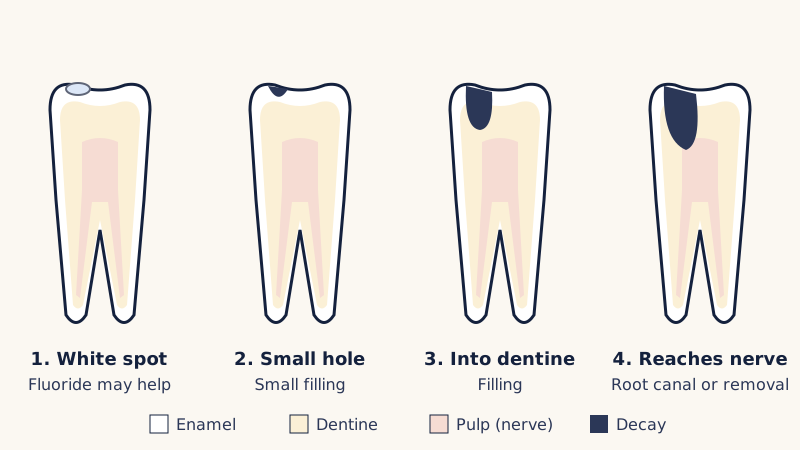
Who it isn’t for:
- A very early white spot with no hole. Fluoride varnish, less sugar and watching it may be enough (Cochrane).
- Decay that has reached the nerve. That needs root canal treatment, or removal if the tooth cannot be saved.
- A large break. When much of the tooth is lost, a crown may protect it better (NHS).
A dentist needs to examine you, and often take an X-ray, to know for sure which one you need.
What happens, step by step
Most fillings take one visit.
-
Check and X-ray. The dentist looks at the tooth and may take an X-ray to see how deep the decay goes. Ask to see it.
-
Numbing. Local anaesthetic numbs the tooth and gum. Small, shallow fillings sometimes do not need it.
-
Removing decay. The soft, decayed part is removed with a drill and hand tools. Healthy tooth is kept.
-
Filling. For composite, the tooth is kept dry, a bonding liquid goes on, and the composite is added in layers and hardened with a blue light. GIC is pressed in and sets by itself.
-
Shaping. The filling is shaped and polished, and your bite is checked with thin paper.
Front teeth usually get tooth-coloured composite, matched to your shade. The aim is a filling that blends in and is smooth to the lip.
Back teeth take the force of chewing. Composite is the usual choice; for a large cavity the dentist may talk about a stronger option, such as an inlay or a crown.
Milk teeth often get GIC, which sets quickly and releases fluoride. See children’s dentistry.
Composite, GIC or amalgam: which filling material?
The FDI World Dental Federation says no single material is right for every situation, and the choice should be made with you (FDI).
| Material | Looks | Strengths | Limits | Often used for |
|---|---|---|---|---|
| Composite (resin) | Tooth-coloured | Bonds to the tooth, can be shaped to look natural | Needs a fully dry tooth; more demanding to place; can fail by breaking or new decay at the edge | Front teeth, small to medium back fillings |
| Glass ionomer (GIC) | Tooth-coloured, less glossy | Simpler to place, releases fluoride, gentle on tissues | Weaker; can wear or break under heavy chewing | Milk teeth, fillings near the gum line, people with high decay risk |
| Amalgam (silver) | Silver-grey | Long track record in back teeth | Contains mercury; being phased down worldwide | Back teeth, now used less |
In trials, composite fillings in back teeth failed about twice as often as amalgam and had more new decay at the edges. The evidence is of low certainty and composites have improved since those trials (Cochrane 2021).
The mercury question
Amalgam is about half mercury by weight. The US FDA says there is no evidence it harms the general population, but it suggests other materials for pregnant or breastfeeding women, children under 6, people with kidney or nerve conditions and people allergic to mercury (FDA). It advises against removing intact amalgam fillings (FDA).
The concern is also environmental. The Minamata Convention on Mercury sets out a phase-down of dental amalgam, and WHO aims for 90% of countries to have phase-down measures by 2030 (WHO). Nepal signed the Convention in 2013 (Minamata Convention).
What’s included, and what may cost extra
| Usually part of a filling | May cost extra |
|---|---|
| Numbing | X-ray of the tooth |
| Removing decay and placing the filling | A base or lining under a deep filling |
| Shaping, polishing and bite check | Root canal treatment if the nerve is involved |
| A crown for a badly broken tooth |
How much a tooth filling costs in Kathmandu
Published Kathmandu Valley clinic prices in October 2026 ranged from NPR 2,000 to 8,000 for a composite filling, depending on size, with most between NPR 2,000 and 3,500. GIC fillings were NPR 1,500 to 2,500. The government teaching hospital (TUTH) listed composite at NPR 1,000 to 2,200 and GIC at NPR 700 to 900.
What changes the price:
- the material
- the size of the cavity and how many surfaces of the tooth it covers
- front or back tooth
- whether you need an X-ray
| Treatment | Our price (NPR) | Typical visits |
|---|---|---|
| Tooth fillings | NPR 2,000 to 3,500 per tooth | 1 |
Compare on the prices page.
Risks, recovery and aftercare
- Numbness lasts a few hours. Avoid hot drinks and chewing on that side until it wears off, so you don’t bite your cheek.
- Sensitivity to cold or pressure is common for a short time.
- New decay can start at the edge of any filling, and fillings can break (Cochrane).
Help your filling last: brush twice a day with fluoride toothpaste, and cut down how often you have sugar. WHO advises keeping free sugars under 10% of daily energy, about 12 level teaspoons, and under 5% for more benefit (WHO).
Get urgent care if
- the tooth throbs, or pain wakes you at night
- your gum or face swells
- you have a fever with tooth pain
Alternatives
| Option | How it works | Time | Upkeep | Best for |
|---|---|---|---|---|
| Fluoride and watching | Varnish and less sugar to stop an early spot | Short visits | Regular checks | White spots with no hole |
| Filling | Decay removed and the hole filled | Usually one visit | Normal brushing, checkups | Small to medium cavities |
| Crown | A cap covers the whole tooth | Two visits | As for natural teeth | Large losses, cracked teeth |
| Root canal treatment | Infected nerve removed, then a filling or crown | One to three visits | Crown often advised on back teeth | Decay in the nerve |
| Extraction | Tooth removed | One visit | Replace the gap if needed | Teeth that cannot be saved |
The dentists who do this treatment

Clean and safe
Fillings use drills and hand instruments that must be sterilised between patients. See how we do it on the sterilisation and safety page. If drills make you anxious, read our nervous patients page.
Sources
- Dental treatments: fillings, NHS (2026)
- Alternative direct restorative materials to dental amalgam, FDI World Dental Federation (2023)
- Composite versus amalgam fillings in back teeth (Worthington et al.), Cochrane (2021)
- Dental amalgam fillings, US FDA (2021)
- Mercury and health, WHO (2024)
- Nepal: party and signatory status, Minamata Convention on Mercury (2026)
- Fluoride varnishes for preventing tooth decay (Marinho et al.), Cochrane (2013)
- Healthy diet: free sugars, WHO (2026)
This page is general information, not a diagnosis. A dentist needs to examine you to know what is right for your teeth.