In short
- Usually 1 to 3 visits of about 1 to 2 hours each, under local anaesthetic.
- One visit works as well as several, but the first week may be a little more sore.
- Published Kathmandu prices ran from NPR 6,000 (front tooth) to NPR 20,000 (molar) in October 2026, crown extra.
- A crown afterwards is the biggest single factor in keeping the tooth long term.
- Not for teeth too broken to repair. Then extraction and a replacement is the option.
Is root canal treatment right for me?
Root canal treatment helps when the pulp inside a tooth is infected or inflamed. This often comes from deep decay, a crack or an abscess (NHS, reviewed October 2025). Signs can include toothache that does not settle, pain when biting, a bad taste or a swollen gum or cheek (NHS toothache).
A dentist needs to examine you, usually with an X-ray, to know for sure.
Who it isn’t for: a tooth that is too broken to repair, or one with too little healthy root left. Then taking the tooth out and replacing it is the honest option. If an abscess is the problem, it will not go away on its own (NHS), so waiting is not a safe choice either.
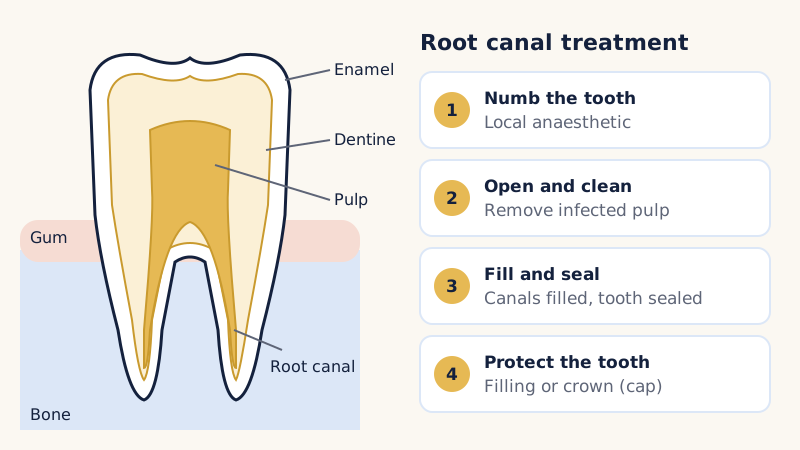
What happens, step by step
This is the typical process. Our dentists will confirm your plan after the exam.
- Exam and X-ray. The dentist checks the tooth and takes an X-ray to see the roots and any infection.
- Numbing. Local anaesthetic numbs the tooth and gum.
- Opening and cleaning. A small opening is made in the top of the tooth. The infected pulp is removed, and the canals are cleaned and shaped with fine instruments.
- Filling and sealing. The canals are filled and sealed. If treatment runs over more than one visit, a temporary filling goes on between visits.
- Protecting the tooth. A permanent filling or a cap (crown) is fitted, often at a later visit.
Each visit usually takes about 1 to 2 hours (NHS).
Some teeth can be finished in a single visit. A Cochrane review (2022) found one visit works as well as several for healing on X-ray. People treated in one visit had somewhat more pain in the first week. Swelling and painkiller use looked about the same.
When there is a lot of infection, or the canals are hard to reach, the dentist may clean the tooth, place medicine and a temporary filling, and finish at the next visit. The NHS says root canal treatment usually takes two or more visits. Keep the temporary filling in place and avoid biting hard on that side until you come back.
What’s included, and what may cost extra
| Part of the root canal itself | Often charged separately |
|---|---|
| Local anaesthetic | Cap (crown) after treatment |
| Cleaning, shaping and filling the canals | X-rays (some clinics include them) |
| Temporary filling between visits | Redoing an old root canal (priced as its own treatment) |
Several Kathmandu clinics state that their RCT price does not include the crown. Ask for both prices together so the total is clear.
How much root canal treatment costs in Kathmandu
Published Kathmandu clinic prices for root canal treatment ranged from NPR 6,000 to 10,000 for a front tooth and NPR 8,000 to 20,000 for a back tooth (molar) in October 2026. Typical molar prices were NPR 11,000 to 16,000. A metal-ceramic crown was typically NPR 13,000 to 15,000, and a zirconia crown NPR 22,000 to 28,000. A government teaching hospital list was lower, at NPR 2,750 to 9,900 for RCT.
What changes the price:
- Which tooth. Back teeth (molars) cost more than front teeth in every published list.
- How infected it is. More infection can mean more visits.
- Re-treatment. Redoing an old root canal is more work.
- The crown material. Metal-ceramic, zirconia or e.max.
- X-rays and any build-up the tooth needs.
| Treatment | Our price (NPR) | Typical visits |
|---|---|---|
| Root canal treatment | NPR 10,000 to 16,000 per tooth, crown extra | 1 to 3 |
See our full price list. For crown options, see dental crowns.
Risks, recovery and aftercare
After treatment your mouth stays numb for a few hours. The area may be swollen and sore for up to a couple of weeks (NHS). Paracetamol or ibuprofen usually helps.
- Do not chew on the tooth until the numbness wears off.
- Avoid biting hard on it until the permanent filling or crown is fitted.
- Keep brushing twice a day and come to your follow-up visits.
How long it lasts: in a large review of studies, 86% of treated teeth survived 2 to 3 years, 93% survived 4 to 5 years and 87% survived 8 to 10 years. Having a crown fitted afterwards was the strongest factor in keeping the tooth (Ng, Mann and Gulabivala, 2010). A treated tooth can still crack or get new decay.
Get urgent care if
- Swelling grows or spreads towards your eye or neck.
- You find it hard to breathe, swallow or open your mouth. Go to a hospital emergency department.
- Pain or swelling gets worse instead of better. Call us.
Alternatives
| Option | How it works | Time | Upkeep | Best for |
|---|---|---|---|---|
| Root canal and crown | Keeps your own tooth, cleaned and sealed inside | 1 to 3 visits, then a crown | Normal brushing, check-ups | A tooth that can be repaired |
| Extraction only | The tooth is taken out and the gap is left | 1 visit | Gap may let teeth shift | A tooth that cannot be saved, when a replacement is not wanted now |
| Extraction and implant | A titanium post in the bone holds a new crown; about 96% survive 10 years (Howe et al., 2019) | 3 to 6 months | Brushing, cleaning, check-ups | Healthy gums and enough bone |
| Extraction and bridge | A false tooth fixed to the teeth either side; about 89% survive 10 years (Pjetursson and Lang, 2008) | About 2 visits | Clean under it daily | Neighbouring teeth that already need caps |
| Extraction and denture | A removable false tooth | A few weeks | Take out and clean daily | Several missing teeth or a lower budget |
Read more about tooth extraction, dental implants and dentures. If you are in pain now, see our emergency dentist page.
The dentists who do this treatment

Clean and safe
Root canal treatment uses fine instruments inside the tooth, so cleaning and sterilising them matters. Read how we clean and sterilise. If you feel nervous, our nervous patients page explains how we can take breaks and go at your pace.
Sources
- Root canal treatment, NHS (2025-10-03)
- Single versus multiple visits for endodontic root canal treatment, Cochrane (2022)
- Tooth survival following non-surgical root canal treatment (Ng, Mann, Gulabivala), International Endodontic Journal (2010)
- A systematic review of the survival of tooth-supported and implant-supported FDPs (Pjetursson and Lang), Journal of Oral Rehabilitation (2008)
- Long-term survival of dental implants (Howe et al.), Journal of Prosthetic Dentistry (2019)
- Toothache, NHS (2024-07-01)
- Dental abscess, NHS (2026-03-18)
This page is general information, not a diagnosis. A dentist needs to examine you to know what is right for your teeth.