In short
- A crown protects a broken, heavily filled or root-canal-treated tooth; a bridge fills a gap of one or a few teeth.
- Usually 2 visits: shape the tooth and take a mould, then fit the final crown.
- Main materials: metal-ceramic (PFM), zirconia and e-max (glass-ceramic).
- Price depends on the material, the number of teeth and whether you need a root canal or build-up first.
- A bridge means trimming the healthy teeth next to the gap; an implant does not.
Is a dental crown right for me?
A crown (cap) covers the whole tooth (NHS). It may help if your tooth is:
- broken or cracked,
- weakened by a very large filling,
- treated with a root canal, especially a back tooth (root canal treatment),
- badly shaped or stained, where a filling or veneer will not do.
A bridge may help if you are missing one or a few teeth and the teeth either side are strong (NHS).
Who it isn’t for:
- A small cavity. A filling does the job and keeps more of your tooth.
- A front tooth that only needs a colour or shape change. Veneers or bonding may remove less tooth.
- A bridge on neighbouring teeth that are weak or have gum disease. Treat the gums first, or consider an implant, which leaves the neighbours alone.
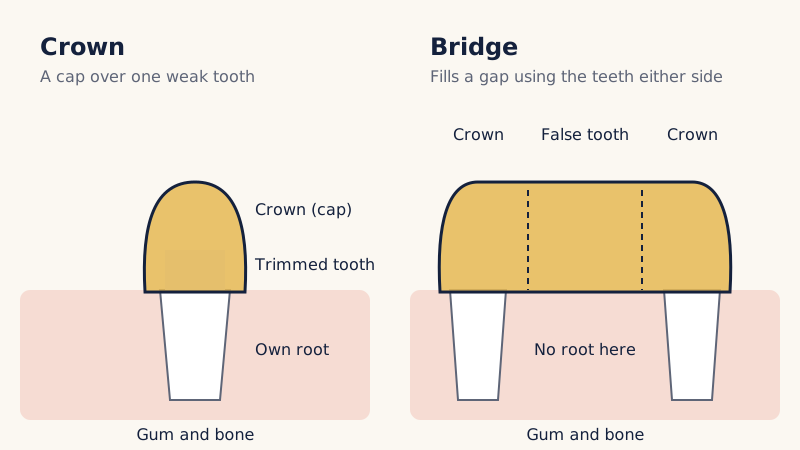
What happens, step by step
-
Check-up and X-ray. The dentist checks the tooth and its root. A tooth with a deep infection may need a root canal first.
-
Shaping the tooth. The tooth is numbed and a thin layer is trimmed so the crown fits over it. For a bridge, the teeth either side of the gap are shaped.
-
Mould or scan. The dentist takes a mould or digital scan and fits a temporary crown to protect the tooth (NHS).
-
Making the crown. A dental lab makes the crown or bridge to match your bite and tooth colour.
-
Fitting. At the second visit the temporary is removed, and the final crown or bridge is checked and fixed in place with dental cement.
Metal-ceramic (porcelain fused to metal, PFM): a metal inner layer with tooth-coloured porcelain on top (NHS). It has the longest track record. In a large review, 94.7% were still in place after 5 years (Sailer et al., 2015). It is the lowest-cost tooth-coloured option in Kathmandu. Ask about a nickel-free metal if you have a metal allergy.
Zirconia: a white ceramic with no metal. In the same review, 92.1% of zirconia crowns were still in place after 5 years, and chipping of the porcelain layered on top was the most reported problem (Sailer et al., 2015). It is the highest-priced of the three in Kathmandu, and the price varies a lot between labs and brands.
E-max (lithium disilicate glass-ceramic): an all-ceramic crown. In the review, 96.6% of this group were still in place after 5 years (Sailer et al., 2015). A dentist needs to check your bite to say if it suits a back tooth.
What’s included, and what may cost extra
| Item | Often in the crown price? | Notes |
|---|---|---|
| Check-up and X-ray | Often separate | Needed to check the root |
| Shaping the tooth, mould or scan | Yes | |
| Temporary crown | Usually | Ask when you book |
| Final crown and fitting | Yes | Material sets the price |
| Root canal treatment | Separate | Root canal prices do not include the crown |
| Core build-up (rebuilding a broken tooth) | Often separate | Needed when little tooth is left |
| Bridge | Priced per unit | A 3-unit bridge is three crowns joined together |
How much a dental crown costs in Kathmandu
Published Kathmandu clinic prices per crown ranged from NPR 6,500 to 45,000 in October 2026, depending on the material:
| Material | Published range (NPR, Oct 2026) | Typical |
|---|---|---|
| Metal-ceramic (PFM) | 6,500 to 15,000 | 13,000 to 15,000 |
| E-max | 12,000 to 26,000 | 20,000 to 26,000 |
| Zirconia | 18,000 to 45,000 | 22,000 to 28,000 |
| 3-unit bridge | PFM about 36,000; zirconia 66,000 to 140,000 |
A government teaching hospital listed lower fees in October 2026 (for example zirconia at NPR 13,200).
What changes the price:
- The material and the lab that makes it.
- How many teeth (one crown, or a bridge of three or more units).
- Whether the tooth needs a root canal or build-up first.
- Front or back tooth, and how closely the colour must match.
| Treatment | Our price (NPR) | Typical visits |
|---|---|---|
| Crowns and bridges | From NPR 13,000 per crown (metal-ceramic) | 2 |
See all our prices on the price list.
Risks, recovery and aftercare
Tell the dentist if the tooth stays sore or the bite feels high after fitting.
Crowns and bridges can chip, come loose or fail over time. In one review, about 89 out of 100 regular bridges were still in place after 10 years, compared with about 80 for cantilever bridges (held on one side only) and 65 for resin-bonded bridges (Pjetursson and Lang, 2008). The tooth under a crown can still decay at the edge, so daily cleaning matters.
Aftercare:
- Brush twice a day with fluoride toothpaste (NHS).
- Clean between teeth every day. Under a bridge, use floss threaders or small between-teeth brushes.
- Come for check-ups so the dentist can check the edges of the crown.
- If you grind your teeth at night, ask about a night guard.
Get urgent care if
- Your crown or bridge comes off, breaks or feels loose. Keep it and see a dentist soon, or an emergency dentist.
- You have severe pain that painkillers do not help.
- Swelling in your mouth or neck makes it hard to breathe, swallow or speak. Go to a hospital emergency department.
Source: NHS dental emergencies.
Alternatives to a crown or bridge
| Option | How it works | Time | Upkeep | Best for |
|---|---|---|---|---|
| Crown | Cap over the whole tooth | Usually 2 visits | Normal brushing and cleaning between teeth | Broken, heavily filled or root-treated teeth |
| Large filling | Repairs the tooth from inside | 1 visit | Normal care | Enough healthy tooth left |
| Bridge | False tooth held by crowns either side | Usually 2 or more visits | Floss threaders under it | A gap with neighbours that already need crowns |
| Implant | Post in the bone holds a crown | About 3 to 6 months | Daily cleaning, check-ups | A gap with healthy neighbours and enough bone |
| Partial denture | Removable plate with false teeth | A few weeks | Take out to clean | Several gaps, lower cost |
| Tooth extraction | Remove the tooth | 1 visit | Plan for the gap | A tooth that cannot be saved |
Our tooth replacement guide compares bridges, implants and dentures in more detail.
The dentists who do this treatment


Clean and safe
Shaping a tooth uses drills and instruments that touch blood and saliva. Read how we clean and sterilise them on our sterilisation and safety page.
Sources
- Dental treatments, NHS (2026)
- All-ceramic or metal-ceramic tooth-supported fixed dental prostheses? A systematic review of the survival and complication rates. Part I: single crowns, Dental Materials (Sailer et al.) (2015)
- Survival and complication rates of tooth- and implant-supported fixed prostheses, Journal of Oral Rehabilitation (Pjetursson, Lang) (2008)
- Outcome of primary root canal treatment: tooth survival, International Endodontic Journal (Ng, Mann, Gulabivala) (2010)
- How to keep your teeth clean, NHS (2025)
- Finding an NHS dentist in an emergency, NHS (2025)
This page is general information, not a diagnosis. A dentist needs to examine you to know what is right for your teeth.