In short
- First visit within 6 months of the first tooth, or by age 1.
- Toothpaste: a smear under 3, a pea-sized amount from 3 to 6, with fluoride.
- Fluoride varnish at least twice a year from age 3; sealants at about 6 to 7 and 11 to 14.
- About half of Nepali children aged 1 to 9 have untreated decay in milk teeth (WHO 2022).
- Published Valley prices for a child's filling ranged from NPR 1,500 to 2,500 in October 2026.
Is children’s dental care right for my child?
Every child benefits from early dental visits, from the first tooth onwards. Decay in milk teeth is very common in Nepal: WHO estimates that 51.2% of children aged 1 to 9 have untreated decay in their milk teeth (WHO 2022). School studies in Kathmandu found decay in 62% of primary schoolchildren (Khanal 2017) and 82% of government-school children aged 6 to 14, most of whom had eaten sugary snacks in the past day (Sundas 2023).
Bring your child sooner if you see:
- white, brown or black spots on the teeth
- a child who avoids chewing on one side or complains of pain
- swelling or a pimple on the gum
- a tooth knocked or broken in a fall
Who it isn’t for, or not first: a child with a swollen face, fever or a knocked-out adult tooth needs urgent care. See emergency dental care. A child with complex medical needs may need a dentist on the specialist register, or a hospital team.
About the title “pediatric dentist”. In Nepal, a pediatric dentist (pedodontist) is a dentist registered as a specialist with the Nepal Medical Council. Many general dentists also care for children. You can check any dentist’s registration on the NMC website.
What happens, step by step
-
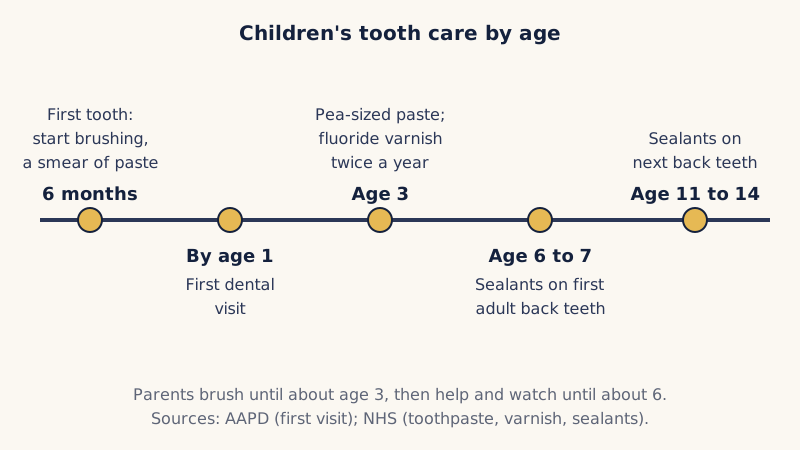
First visit, by age 1. Within six months of the first tooth, or by the first birthday (AAPD). Your child usually sits on your lap while the dentist looks at the teeth and gums.
-
Advice for you. Brushing from the first tooth with a smear of toothpaste with at least 1,000 ppm fluoride; parents do the brushing until about age 3 (NHS).
-
Feeding. No falling asleep with a bottle, and moving off the bottle at 12 to 14 months (AAPD).
-
Checkup. The dentist counts and checks the teeth and looks for early decay.
-
Fluoride varnish. A quick paint-on fluoride, at least twice a year from age 3 (NHS). It reduced decayed, missing or filled surfaces by about 37% in milk teeth (Cochrane).
-
Brushing. A pea-sized amount of 1,000 to 1,500 ppm fluoride toothpaste; you help and watch (NHS).
-
Habits. Thumb-sucking is best discouraged after age 4 (AAPD).
-
Checkup and varnish, as before. Fluoride varnish reduced decay in adult teeth by about 43% (Cochrane).
-
Sealants. When the adult back teeth come through, at about 6 to 7 and 11 to 14, their grooves can be sealed (NHS). In trials, where 40% of unsealed surfaces decayed in 2 years, only about 6% of sealed ones did (Cochrane).
-
Fillings if needed, often with glass ionomer in milk teeth. See tooth fillings.
-
Bite and spacing. The dentist watches how adult teeth come in and tells you if a braces check may be useful later.
If your child is nervous: short visits, simple words and “tell, show, do” come first. Sedation is considered only when simpler methods are not enough (NHS England). Oral midazolam sedation probably helps children cope, with few and minor side effects (Cochrane). It needs a pre-assessment and written consent. Our nervous patients page has more.
Fluoride: how much, and is it safe?
Fluoride toothpaste prevents decay, and stronger pastes (1,450 to 1,500 ppm) work slightly better than 1,000 to 1,250 ppm in children and teenagers (Cochrane). The same review says to weigh the risk of fluorosis (white marks from swallowing too much fluoride while teeth form) in young children, which is why the amount on the brush matters:
| Age | Amount | Fluoride strength | Who brushes |
|---|---|---|---|
| First tooth to 3 | A smear | At least 1,000 ppm | You |
| 3 to 6 | Pea-sized | 1,000 to 1,500 ppm | Your child, with your help |
| 7 and over | Pea-sized | 1,350 to 1,500 ppm | Your child, checked by you |
Teach your child to spit out after brushing, not rinse (NHS). The strength is printed on the tube in ppm.
What’s included, and what may cost extra
| Usually part of a child’s checkup | May cost extra |
|---|---|
| Check of teeth, gums and bite | Fluoride varnish |
| Brushing, diet and habit advice for you | Fissure sealants |
| A plan for next visits | X-rays, if needed |
| Fillings or nerve treatment (pulpectomy) |
How much children’s dental care costs in Kathmandu
Published Kathmandu Valley clinic prices in October 2026 ranged from NPR 1,500 to 2,500 for a child’s filling, NPR 400 to 3,000 for fluoride treatment, about NPR 1,500 for a sealant and NPR 4,000 to 7,000 for a milk-tooth nerve treatment (pulpectomy). The government teaching hospital (TUTH) listed fluoride at NPR 850, sealants at NPR 800 and pulpectomy at NPR 1,650 to 2,000.
What changes the price:
- prevention only, or treatment as well
- how many teeth need sealants or fillings
- whether X-rays are needed
- how many visits a nervous child needs
| Treatment | Our price (NPR) | Typical visits |
|---|---|---|
| Children’s dentistry | From NPR 600 first visit | 1 |
See the prices page.
Risks, recovery and aftercare
Checkups, fluoride varnish and sealants are quick and do not need numbing. After a filling, watch that your child does not bite a numb lip or cheek.
Day to day:
- Brush twice a day, last thing at night, with the right amount of fluoride toothpaste.
- Keep sugary snacks and drinks to mealtimes; WHO advises keeping free sugars under 10% of daily energy (WHO).
- Water or milk between meals; no bottle in bed.
Get urgent care if your child has
- a swollen face or cheek, or a fever with tooth pain
- an adult tooth knocked out (put it back or keep it in milk and come straight away)
- a mouth injury that will not stop bleeding
Alternatives
| Option | How it works | Time | Upkeep | Best for |
|---|---|---|---|---|
| Home care only | Brushing with fluoride, less sugar | Daily | Every day | All children, but misses early decay |
| Prevention visits | Checkup, varnish, sealants | Short visits | Every few months, set by risk | Most children |
| Fillings | Decay removed, tooth filled | One visit per tooth or two | Checkups | Holes in milk or adult teeth |
| Nerve treatment or removal | Pulpectomy, or taking out the tooth | One or more visits | Space may need holding | Decay into the nerve, infection |
The dentists who do this treatment

Clean and safe
Instruments used for children need the same cleaning and sterilising between patients as for adults. Read how we do it on the sterilisation and safety page. The first visit page explains what to bring.
Sources
- Dental home: it's never too early to start, American Academy of Pediatric Dentistry (undated)
- Taking care of children's teeth, NHS (2025)
- Nepal oral health country profile, WHO (2022)
- Dental caries among Kathmandu government-school children (Sundas et al.), Journal of Kathmandu Medical College (2023)
- Caries among Kathmandu primary schoolchildren (Khanal et al.), J Coll Med Sci Nepal (2017)
- Fluoride varnishes for preventing tooth decay (Marinho et al.), Cochrane (2013)
- Sealants for preventing tooth decay (Ahovuo-Saloranta et al.), Cochrane (2017)
- Fluoride toothpastes of different strengths (Walsh et al.), Cochrane (2019)
- Sedation of children for dental treatment (Ashley et al.), Cochrane (2018)
This page is general information, not a diagnosis. A dentist needs to examine you to know what is right for your teeth.