In short
- For chips, small gaps, uneven shapes and stains that whitening can't lift.
- Bonding: one visit, about 30 to 60 minutes a tooth, usually no enamel removed.
- Porcelain veneers: two or more visits, stain less, and last longer.
- Neither suits heavy grinding without a night guard, or teeth with big decay.
- Price is per tooth, so the number of teeth sets most of the cost.
Are veneers or bonding right for me?
Veneers and bonding help with front teeth that are chipped, slightly gapped, uneven in shape, or stained in a way whitening can’t lift (Cleveland Clinic). They change how a tooth looks. They don’t move teeth or fix the bite.
They may not be right if:
- you grind or clench your teeth and won’t wear a night guard, because veneers can chip or come off;
- a tooth has big decay or a large filling. A crown may protect it better;
- your teeth are crowded or crooked. Braces or clear aligners move them, and veneers on crooked teeth may need more enamel removed;
- you only want whiter teeth. Teeth whitening changes colour without covering the tooth.
A dentist needs to examine you to know which option suits your teeth.
What happens, step by step
-
Shade and plan. The dentist checks the tooth and picks a resin colour to match. If you want whiter teeth, whiten first.
-
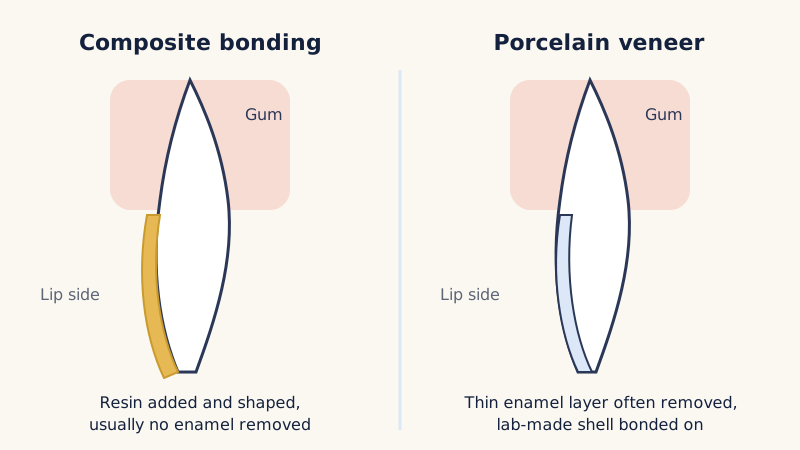
Prepare the surface. The front of the tooth is roughened slightly so the resin sticks. Bonding usually needs no enamel removed (Cleveland Clinic).
-
Build and shape. Tooth-coloured resin is added in layers, shaped and hardened with a blue light.
-
Polish. The dentist checks your bite and polishes the surface. It takes about 30 to 60 minutes per tooth (Cleveland Clinic), all in one visit.
-
Plan. The dentist checks your teeth and gums, takes photos and moulds or a scan, and agrees the shape and shade with you.
-
Prepare. The tooth is numbed and a thin layer of enamel is often removed from the front so the veneer sits flush (NHS).
-
Lab work. A dental lab makes each veneer to fit. You may wear temporary covers in the meantime.
-
Fit. At the next visit the dentist checks the fit and colour, then glues the veneers on and checks your bite.
What’s included, and what may cost extra
| Usually in the price per tooth | Often extra (ask) |
|---|---|
| Shade matching | Check-up and X-rays |
| The bonding or veneer itself | Teeth whitening before treatment |
| Fitting and bite check | Scaling and polish |
| A night guard if you grind | |
| Mock-up or trial smile, if offered |
How much veneers cost in Kathmandu
Published Kathmandu clinic prices for composite veneers or bonding ranged from NPR 5,000 to 10,000 per tooth in October 2026. Porcelain veneers ranged from NPR 15,000 to 25,000 per tooth. Most clinic pages were not dated.
What changes the price:
- Material: composite resin or porcelain.
- How many teeth you treat.
- Whitening or cleaning before treatment.
- A night guard if you grind your teeth.
| Treatment | Our price (NPR) | Typical visits |
|---|---|---|
| Veneers and bonding | From NPR 8,000 per tooth, composite bonding | 1 to 3 |
See our full price list.
Risks, recovery and aftercare
Bonding is somewhat stain-resistant, but stains more than porcelain and can chip over time. It usually lasts 3 to 10 years before it needs a touch-up or replacement (Cleveland Clinic).
Porcelain veneers last well. A review of 25 studies and about 6,500 veneers found 95.5% still in place after 10 years (Alenezi et al. 2021). The most common problems were cracks and veneers coming loose, mostly in the first years. Removed enamel does not grow back.
Neither bonding nor porcelain gets lighter with whitening, which only works on natural teeth (NHS).
To make them last:
- Don’t bite nails, pens, bones or hard sweets with your front teeth.
- Wear a night guard if you grind.
- Brush, floss and keep up regular cleanings.
See a dentist soon if
- a veneer or bonding cracks, chips or comes loose (keep any piece);
- a treated tooth becomes painful or very sensitive;
- your gum around a treated tooth swells or bleeds.
Alternatives
| Option | How it works | Time | Upkeep | Best for |
|---|---|---|---|---|
| Composite bonding | Resin shaped onto the tooth | One visit | Polish; touch-ups over time | Small chips, gaps, one dark tooth |
| Porcelain veneers | Lab-made shells glued on | 2 or more visits | Check-ups; avoid biting hard things | Several front teeth, deep stains, longer life |
| Teeth whitening | Bleaching gel lightens natural teeth | 1 hour or a few weeks | Top-ups | Overall yellow teeth with a good shape |
| Crowns | A cap over the whole tooth | 2 visits | Check-ups | Weak, broken or root-filled teeth |
| Braces or aligners | Moves teeth into line | Months to years | Retainer after | Crowded or crooked teeth |
See how these fit together on our cosmetic dentistry page.
The dentists who do this treatment

Clean and safe
Read how we clean and sterilise instruments on our sterilisation and safety page. Worried about the drill or injections? See help for nervous patients.
Sources
- Dental treatments, NHS (2026)
- Dental bonding, Cleveland Clinic (2026)
- Factors affecting the survival of porcelain veneers: a systematic review (Alenezi et al.), Journal of Clinical Medicine (2021)
- Teeth whitening, NHS (2025)
This page is general information, not a diagnosis. A dentist needs to examine you to know what is right for your teeth.