In short
- In-clinic whitening takes about an hour; take-home trays take a few weeks.
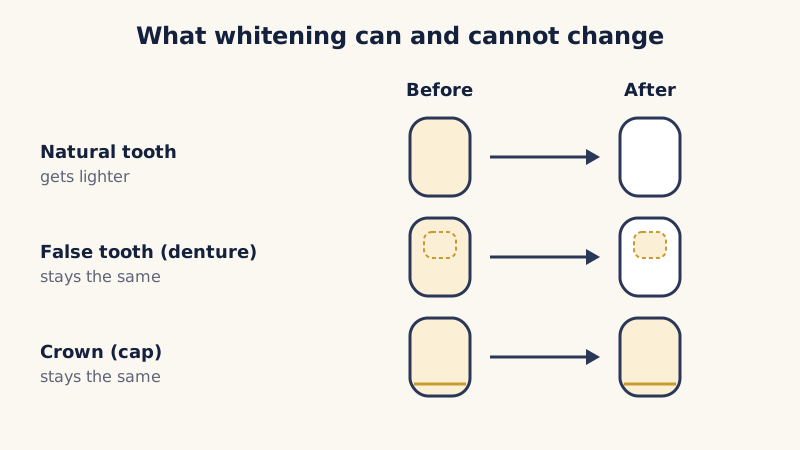
- Only natural teeth get lighter. Crowns, false teeth and implants stay the same colour (NHS).
- Sensitivity and sore gums are the common side effects, and they usually pass.
- Not done for under-18s, or in pregnancy or breastfeeding.
- The result fades over time; tea, coffee, paan and tobacco speed this up.
Is teeth whitening right for me?
Whitening helps if your natural teeth have turned yellow or darker over time, from age, tea, coffee or tobacco. In Nepali many people call this “पहेंलो रङको दाँत” (yellow teeth). It is a cosmetic treatment: it changes colour, not health.
Whitening is not for you if (NHS):
- you are 17 or younger;
- you are pregnant or breastfeeding;
- the teeth you want lighter are crowns, false teeth or implants. Bleach only works on natural teeth.
It may also need to wait if you have decay, gum disease or very sensitive teeth. A dentist needs to examine you first, because a dark single tooth can be a sign of a problem inside the tooth.
What happens, step by step
-
Check-up. The dentist checks for decay, gum problems and crowns on your front teeth. They record your starting shade.
-
Cleaning. A scaling and polish first removes tartar and surface stains, so the gel reaches the tooth evenly.
-
Whitening. In the clinic, or at home with trays (see below).
-
Review. You compare your shade with the start. If a front crown no longer matches, the dentist talks through options.
In-clinic or take-home?
In-clinic whitening uses a stronger gel that the dentist applies while your gums are protected. Some clinics use a light with it. It takes about an hour (NHS).
- Quickest change, in one or two visits.
- Stronger gels cause more sensitivity for some people (Cochrane).
- Good if you have a close date, such as a wedding.
Take-home whitening uses thin trays made to fit your teeth and a weaker gel from your dentist. You wear the trays at home for around 2 to 6 weeks (NHS).
- Slower, but you control the pace.
- You can stop for a few days if your teeth feel sensitive.
- The trays can be used again later for top-ups.
Some people start in the clinic and finish with take-home trays. This gives a quick first change, then a slower, steady finish. Ask the dentist whether it suits your teeth.
What’s included, and what may cost extra
| Usually in the whitening price | Often extra (ask) |
|---|---|
| Shade check before and after | Check-up and X-rays if needed |
| Whitening session or the gel | Scaling and polish beforehand |
| Gum protection in the clinic | Custom trays (for take-home) |
| Extra gel for top-ups | |
| Replacing front crowns to match |
How much teeth whitening costs in Kathmandu
Published Kathmandu clinic prices for in-clinic whitening ranged from NPR 8,000 to 22,000 in October 2026, with most around NPR 15,000 to 18,000. Take-home kits ranged from NPR 8,000 to 19,000. The prices come from clinic websites; most were not dated.
What changes the price:
- Method: in-clinic, take-home or both.
- Number of sessions in the clinic.
- Whether the trays and gel are included for take-home.
- Cleaning first, if you need it.
| Treatment | Our price (NPR) | Typical visits |
|---|---|---|
| Teeth whitening | NPR 10,000 to 20,000 in-clinic, both jaws | 1 to 2 |
See our full price list.
Risks, recovery and aftercare
A Cochrane review of 71 trials found bleaching gels whiten teeth over 2 weeks to 6 months. The most common side effects were sensitivity and gum irritation. These were mild, passed, and were more common with stronger gels (Cochrane). The NHS also lists sore throat and white patches on the gums (NHS). Long-term results are not well studied.
To help it settle and last:
- Use a toothpaste for sensitive teeth before and during whitening.
- Keep to the gel times your dentist sets. More gel does not mean whiter teeth.
- For a day or two after, go easy on tea, coffee and turmeric-heavy food.
- Avoid charcoal, lemon and rough tooth powders. A Nepali dentist warns that they wear enamel away (Nepallive).
See a dentist soon if
- sensitivity is severe or doesn't settle a few days after you stop;
- your gums blister, bleed or stay white and sore;
- one tooth hurts on its own or turns darker.
Alternatives
| Option | How it works | Time | Upkeep | Best for |
|---|---|---|---|---|
| Teeth whitening | Bleaching gel lightens natural teeth | 1 hour in clinic, or 2 to 6 weeks at home | Top-ups; fewer staining drinks | Overall yellow or dull teeth |
| Scaling and polish | Removes tartar and surface stain | One visit | Usually once a year | Stains on the surface, not tooth colour |
| Composite bonding | Tooth-coloured resin covers the front | One visit per tooth | Polish; may need touch-ups | One dark or chipped tooth |
| Porcelain veneers | Thin shells cover the front | 2 or more visits | Check-ups; avoid biting hard things | Deep stains whitening can’t lift |
| Crowns | A cap over the whole tooth | 2 visits | Check-ups | Badly broken or root-filled teeth |
See all options on our cosmetic dentistry page.
The dentists who do this treatment

Clean and safe
Read how we clean and sterilise instruments on our sterilisation and safety page. If dental visits make you anxious, see help for nervous patients.
Sources
- Teeth whitening, NHS (2025)
- Dental treatments, NHS (2026)
- Home-based chemically-induced whitening (bleaching) of teeth in adults, Cochrane (2018)
- Dental hygiene advice from a Nepali dentist (Nepali), Nepallive (2021)
This page is general information, not a diagnosis. A dentist needs to examine you to know what is right for your teeth.