In short
- Best suited to mild to moderate crowding or gaps.
- They only work if you wear them for most of the day and night.
- Fewer check-up visits than braces, but more self-discipline.
- You need a retainer afterwards, the same as with braces.
- Price depends on how many trays you need, extra refinement trays, and what is included.
Are clear aligners right for me?
Clear aligners suit people with mild to moderate crowding or small gaps who want treatment that is hard to see and can come out for meals (Tamer et al. 2019). They can also treat some bite problems, such as an overbite or crossbite (AAO).
They are not right for everyone (FDA). Aligners may not be the best choice if:
- your teeth are badly crowded or rotated, or need to move up or down a lot. A 2019 review found these movements are harder with aligners than with fixed braces (Tamer et al. 2019);
- you need teeth taken out and the spaces closed;
- you won’t wear them for most of the day and night. Aligners left in a drawer don’t move teeth;
- you have gum disease or decay that needs treating first.
If aligners don’t fit your case, braces usually can. Compare both on the teeth straightening page. A dentist needs to examine you to know for sure.
Invisalign is one brand. Several aligner systems are sold in Nepal. Ask which system your dentist uses and what the price includes.
What happens, step by step
-
Consultation. The dentist checks your teeth, gums and bite and tells you honestly whether aligners can do what you want.
-
Records. X-rays, photos and a scan or moulds of your teeth.
-
Plan. A computer plan shows how each tooth should move, tray by tray. You see the expected end result and the number of trays before you agree.
-
First trays. Small tooth-coloured bumps called attachments may be glued to some teeth to help the trays grip (AAO). You learn how to put trays in, take them out and clean them.
-
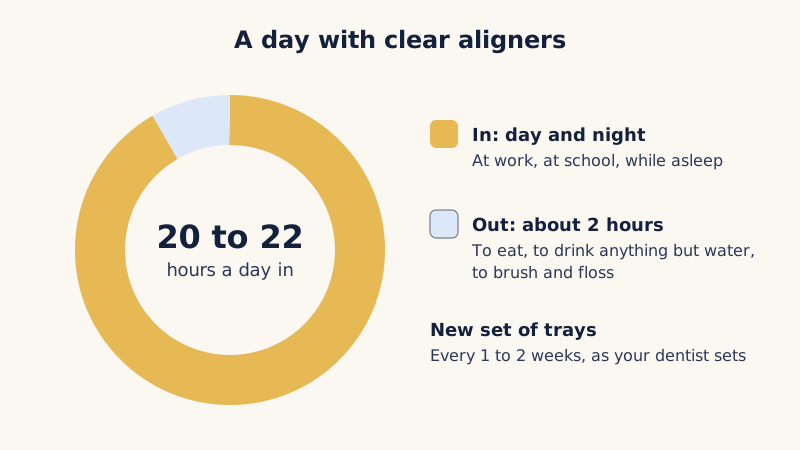
Wear and change. Wear your trays 20 to 22 hours a day (FDA, AAO). Switch to the next set every 1 to 2 weeks, as your dentist tells you.
-
Check-ups. You need fewer visits than with braces, which in Kathmandu need monthly check-ups (Onlinekhabar). Visits still matter: the FDA says in-person checks help make sure teeth are moving safely.
-
Refinements. Teeth don’t always move as far as planned. One study in the 2019 review found only 41% of planned movement was reached on average (Tamer et al. 2019), so some people need extra trays at the end.
-
Retainer. When the last tray is done, a retainer holds your teeth in place.
What fits your situation?
This is where aligners do best. Treatment is often shorter, with fewer trays. Your dentist can tell you how many trays to expect after the scan.
Some bite problems can be treated with aligners, but heavy crowding, big rotations and closing extraction spaces are harder. Your dentist may suggest fixed braces, or braces for part of the treatment.
If your teeth shifted because a retainer was not worn, a short course of aligners may move them back. A new retainer is then needed to hold them.
Living with aligners
- Take them out to eat and to drink anything but water (AAO).
- Brush before you put them back, so food isn’t trapped against your teeth.
- Keep the case with you. Wrapping trays in a napkin at a meal is the easiest way to lose them.
- Speech: some people lisp for the first few days (FDA).
What’s included, and what may cost extra
| Usually in the aligner price | Often extra (ask) |
|---|---|
| Records and treatment plan | X-rays |
| All planned trays | Refinement trays after the first series |
| Attachments | Replacement for lost trays |
| Check-up visits | Retainers |
| Cleaning or fillings before you start |
How much clear aligners cost in Kathmandu
Published Kathmandu clinic prices for clear aligners ranged from NPR 120,000 to 400,000 in October 2026, with most clinics starting at NPR 150,000 to 200,000. Most clinic pages were not dated. Aligners usually cost more than metal or ceramic braces.
What changes the price:
- How complex your case is, which sets the number of trays.
- The aligner system your dentist uses.
- Refinements: whether extra trays are included.
- Retainers and replacement trays.
- X-rays and any treatment needed before you start.
| Treatment | Our price (NPR) | Typical visits |
|---|---|---|
| Clear aligners | From NPR 1,50,000 full treatment | Every 6 to 8 weeks |
See the full price list.
Risks, recovery and aftercare
Aligners are safe when a dentist plans and checks them. The FDA lists these problems (FDA):
- sore teeth or gums, irritation, and rarely an allergic reaction to the plastic;
- cuts or swelling from a rough tray edge;
- a short change in speech;
- lost or damaged trays.
The FDA has not authorised aligners sold straight to the public without a dentist or orthodontist. It has had reports of pain, bite problems and new gaps after unsupervised treatment.
Get urgent care if
- you have swelling of the lips, tongue or face, or trouble breathing, after putting in a tray;
- pain doesn't settle after a few days on a new tray;
- a tooth feels very loose or your bite suddenly feels wrong.
Retainers. Your teeth can move back after treatment. A 2023 Cochrane review found no type of retainer is clearly better than another (Cochrane). Your dentist will tell you how long to wear yours.
Alternatives
| Option | How it works | Time | Upkeep | Best for |
|---|---|---|---|---|
| Clear aligners | Removable clear trays, changed every 1 to 2 weeks | Depends on the case | Wear 20 to 22 hours a day; clean trays | Mild to moderate crowding or gaps |
| Metal or ceramic braces | Brackets and a wire, fixed on | 1 to 2 years | Monthly visits; careful cleaning | Most cases, including heavy crowding and rotations |
| Bonding or veneers | Changes the shape of front teeth; doesn’t move them | 1 to 3 visits | Check-ups and polish | Small gaps or chips when the bite is fine |
| No treatment | Keep your teeth as they are | None | Normal check-ups | Mild crowding that doesn’t bother you |
The dentists who do this treatment

Clean and safe
Read how we clean and sterilise instruments on our sterilisation and safety page. Nervous about a first visit? See help for nervous patients and what happens at your first visit.
Sources
- Clear dental aligners, US Food and Drug Administration (2026)
- Clear aligners, American Association of Orthodontists (2026)
- Orthodontic treatment with clear aligners and the scientific reality behind their marketing: a literature review, Turkish Journal of Orthodontics (2019)
- Retention procedures for stabilising tooth position after treatment with orthodontic braces, Cochrane (2023)
- Dental treatment costs and follow-up in Nepal (Nepali), Onlinekhabar (2023)
This page is general information, not a diagnosis. A dentist needs to examine you to know what is right for your teeth.