In short
- One visit: your history, a check of teeth, gums, tongue and cheeks, and advice.
- X-rays only when they are needed, not at every visit.
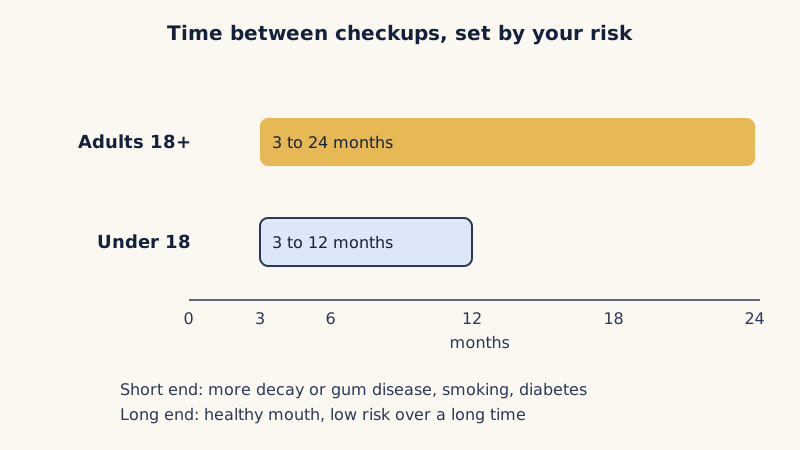
- Next visit set by your risk: 3 to 24 months for adults, 3 to 12 months for under-18s.
- Published Kathmandu Valley checkup fees ranged from NPR 200 to 1,000 in October 2026.
Is a dental checkup right for me?
A checkup suits anyone who has no urgent problem and wants to know the state of their teeth and gums. Decay and gum disease often cause no pain at first, so a checkup can find them while they are small and cheaper to treat.
It is a good time to come if:
- you have not seen a dentist for a year or more, or never
- your gums bleed when you brush, or you have bad breath
- you smoke, chew tobacco, gutkha or paan
- you have diabetes, are pregnant, or take medicines that dry your mouth
- you want a plan and an estimate before deciding on any treatment
Who it isn’t the right visit for: if you have strong toothache, a swollen face, a broken tooth or bleeding that will not stop, you need an urgent visit. See emergency dental care.
What happens, step by step
A checkup is usually one visit.
-
Your history. The dentist asks about pain, sensitivity, bleeding gums, your health, medicines, pregnancy, smoking or tobacco and how often you have sugary food and drinks.
-
Teeth. Each tooth is checked for decay, cracks, worn or broken fillings and crowns.
-
Gums. The dentist gently measures the gap between gum and tooth and looks for bleeding, tartar and receding gums.
-
The rest of the mouth. Tongue, cheeks, lips and the floor of the mouth are checked for ulcers, red or white patches and lumps. This matters in Nepal, where WHO counted 844 new lip and mouth cancers in 2020 and 31.5% of adults use tobacco (WHO 2022). Chewing tobacco, betel nut and paan raise the risk (NHS).
-
X-rays, only if needed. X-rays are not needed at every visit. How often depends on your age and risk (ADA MouthHealthy).
-
Plan and next date. You hear what was found, what needs treatment now, what can wait, the cost of each option and when to come back.
How often should I have a dental checkup?
Not every 6 months for everyone. The UK’s NICE guideline CG19 says the time between checkups should be set for each person by their risk: from 3 months up to 24 months for adults, and from 3 months up to 12 months for under-18s. Gaps shorter than 3 months are not normally needed (NICE CG19, NHS).
A Cochrane review found that for adults over 4 years, 6-monthly, 24-monthly and risk-based checkups made little or no difference to decay, gum bleeding or quality of life. There was not enough evidence to say the same for children (Cochrane 2020).
You are likely to need shorter gaps if you have new decay, gum disease, a dry mouth, diabetes, or you smoke or chew tobacco. Children’s teeth change fast, so they are seen more often.
What’s included, and what may cost extra
| Usually part of a checkup | May cost extra |
|---|---|
| Your history and questions | X-rays (single tooth or full mouth) |
| Check of teeth, gums and soft tissues | Teeth cleaning (scaling and polishing) |
| Explanation of findings and options | Fillings or other treatment |
| Written plan with estimates and next date | Deep cleaning for gum disease |
How much a dental checkup costs in Kathmandu
Published Kathmandu Valley clinic fees for a consultation or checkup ranged from NPR 200 to 1,000 in October 2026, most between NPR 500 and 700. A single-tooth X-ray was listed at NPR 400 to 500 and a full-mouth (OPG) X-ray at NPR 1,000 to 2,000.
What changes the price:
- whether you need X-rays, and which kind
- whether a cleaning is done at the same visit
- a consultation with a dentist on the specialist register usually costs more
| Treatment | Our price (NPR) | Typical visits |
|---|---|---|
| Dental checkup | From NPR 600 per visit | 1 |
See the full prices page.
Risks, recovery and aftercare
A checkup has almost no risks. Inflamed gums may bleed a little when checked. Dental X-rays use very low doses: a single dental X-ray is about 0.005 mSv, roughly one day of natural background radiation (RadiologyInfo). The ADA expert panel said in 2024 that thyroid and tummy shielding is no longer needed for any patient, including in pregnancy (ADA MouthHealthy).
Between checkups, brush for about 2 minutes twice a day with fluoride toothpaste, spit out without rinsing, and clean between your teeth.
See a dentist or doctor soon if
- a mouth ulcer lasts more than 3 weeks
- you notice a red or white patch, or a lump in the mouth, lip or neck
- swallowing or speaking becomes hard or painful
These can be signs of mouth cancer, though most are caused by other things (NHS).
Alternatives
| Option | How it works | Time | Upkeep | Best for |
|---|---|---|---|---|
| Checkup only | Exam, advice, plan | One short visit | Next visit at your risk-based gap | Low-risk, healthy mouths |
| Checkup and cleaning | Exam plus scale and polish | One visit, a bit longer | Same | Tartar, stains, bleeding gums |
| Emergency visit | Focused on one urgent problem | One visit | A full checkup later | Pain, swelling, broken teeth |
| Waiting until it hurts | No visit until pain | None | Treatment is often bigger by then | Not advised |
Clean and safe
Even a checkup uses instruments in your mouth. Read how we clean and sterilise them on the sterilisation and safety page. If it is your first visit, see what to expect at your first visit.
Sources
- Dental checks: intervals between oral health reviews (CG19), NICE (2004)
- Dental check-ups, NHS (2025)
- How often should you have a dental check-up? (Fee et al.), Cochrane (2020)
- X-rays, American Dental Association (MouthHealthy) (2026)
- Radiation dose in X-ray and CT exams, RadiologyInfo (ACR, RSNA) (2025)
- Mouth cancer: symptoms, NHS (2023)
- Mouth cancer: causes, NHS (2023)
- Nepal oral health country profile, WHO (2022)
This page is general information, not a diagnosis. A dentist needs to examine you to know what is right for your teeth.