In short
- Signs: bleeding, swollen or red gums, bad breath, receding gums, loose teeth.
- Steps: gum check and measurements, deep cleaning, review, then regular maintenance.
- Gingivitis is reversible; periodontitis can be controlled but lost bone does not grow back by itself.
- Smokers have twice the risk of gum disease; diabetes and gum disease affect each other.
- Published Valley prices for deep cleaning ranged from NPR 3,000 to 10,000 a session in October 2026.
Is gum treatment right for me?
Gum treatment is for gums that bleed, swell or pull back, caused by plaque and tartar building up around the teeth. Signs include bleeding when you brush, red or sore gums, bad breath, receding gums and loose teeth (NHS). In Nepal, WHO estimates that 14.8% of people aged 15 and over have severe gum disease (WHO 2022).
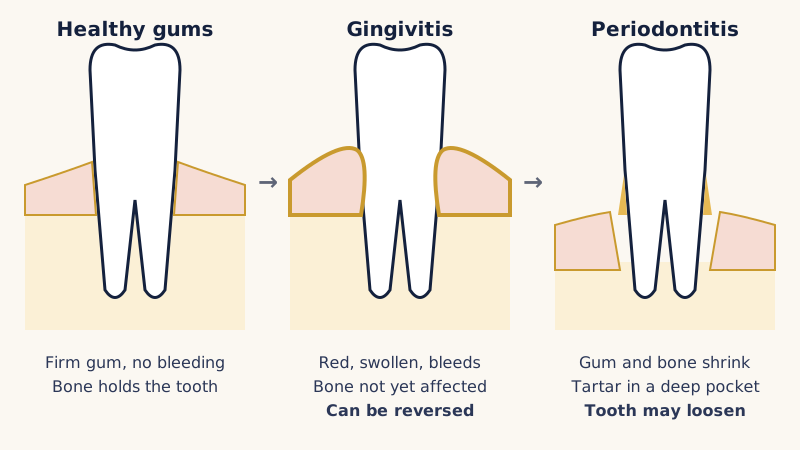
- Gingivitis (early gum disease) is reversible (CDC). A scale and polish and better brushing are often enough.
- Periodontitis means the gum and bone around the tooth have been damaged. Dentists describe it by stage (I to IV, how severe) and grade (A to C, how fast it is getting worse). Smoking and diabetes can push the grade up (2017 world workshop classification).
Who it isn’t for, or not yet:
- If your face is swollen, you have a fever or a painful gum boil, you need an urgent visit first. See emergency dental care.
- If a tooth has very little bone left, cleaning may not save it, and tooth extraction may be the safer choice. A dentist needs to examine you and take X-rays to know for sure.
- If you have an implant with bleeding gums around it, the cause and care are similar, but tell the dentist it is an implant.
What happens, step by step
-
Gum check. The dentist asks about bleeding, smoking or tobacco, diabetes and medicines. They gently measure the gap between gum and tooth (the pocket) around each tooth, and take X-rays to see the bone level.
-
Plan and estimate. You get the stage of your gum disease, the number of visits and the cost before treatment starts.
-
Deep cleaning. After numbing, the dentist removes tartar from below the gum line and smooths the root surfaces (scaling and root planing). With heavy tartar or weak teeth this is often done one area at a time over two or more visits (Onlinekhabar, Dr Biplav Adhikari).
-
Review. At a later visit the dentist measures the pockets again to see how the gums have healed.
-
More treatment if needed. Deep pockets that do not heal may need antibiotics, gum surgery or, for a tooth that cannot be saved, removal (NHS).
-
Maintenance. Regular cleans and checks at an interval your dentist sets, because gum disease can come back.
What’s included, and what may cost extra
| Usually part of gum treatment | May cost extra |
|---|---|
| Gum check and pocket measurements | X-rays (often a separate item on Kathmandu price lists) |
| Deep cleaning per session or area | Gum surgery (often priced per area of the mouth) |
| Numbing for deep cleaning | Antibiotics or a prescribed mouthwash |
| Home-care advice | Extractions, fillings or replacement teeth |
How much gum treatment costs in Kathmandu
Published Kathmandu Valley clinic prices for deep cleaning or gum treatment ranged from NPR 3,000 to 10,000 per session in October 2026. Gum (flap) surgery was listed at about NPR 8,000 per area, and severe cases at NPR 10,000 to 18,000 or more. The government teaching hospital (TUTH) listed flap surgery at NPR 4,950 per quarter of the mouth.
What changes the price:
- the stage of gum disease and how many teeth are involved
- how many sessions the deep cleaning needs
- X-rays, surgery or medicines
- how often you need maintenance cleans afterwards
| Treatment | Our price (NPR) | Typical visits |
|---|---|---|
| Gum treatment | From NPR 4,000 per session | 2 to 4 |
See the full prices page.
Diabetes, smoking and your gums
Diabetes. Gum disease and diabetes affect each other. Gum disease raises the risk of type 2 diabetes and makes blood sugar harder to control. Gum treatment is safe for people with diabetes and lowered HbA1c by 0.27 to 0.48 percentage points at 3 months (EFP and IDF consensus, 2018). People with diabetes also heal more slowly and get dry mouth and thrush more often, so tell your dentist you have diabetes (NIDCR).
Smoking and tobacco. Smokers have twice the risk of gum disease of non-smokers, and gum treatment may not work as well for them (CDC). WHO estimates that 31.5% of people aged 15 and over in Nepal use tobacco (WHO 2022). Stopping helps your gums heal (NHS).
Risks, recovery and aftercare
After deep cleaning, gums can feel sore and teeth sensitive for a few days. As swelling goes down, gums may sit lower, so teeth can look longer and gaps between them may show. That is the gum settling after inflammation, not damage from cleaning.
A chlorhexidine mouthwash may be prescribed for a short time. It reduces plaque well, but it can stain teeth brown after about 4 weeks of use (Cochrane).
Aftercare (NHS):
- Brush twice a day with fluoride toothpaste; spit, don’t rinse.
- Clean between your teeth every day with floss or interdental brushes.
- Don’t use mouthwash straight after brushing.
- Don’t smoke, and keep your maintenance visits.
Get urgent care if
- your gum or face swells, or you notice pus
- you have a fever with gum pain
- bleeding from the mouth will not stop
Alternatives
| Option | How it works | Time | Upkeep | Best for |
|---|---|---|---|---|
| Better home care alone | Brushing and cleaning between teeth | Daily | Every day | Very mild gingivitis |
| Scale and polish | Removes tartar above the gum line | Usually one visit | Regular cleans | Gingivitis, no deep pockets |
| Deep cleaning | Removes tartar below the gum line | Often two or more visits | Maintenance cleans | Periodontitis with pockets |
| Gum surgery | Opens the gum to clean deep roots | One or more visits | Maintenance cleans | Deep pockets that do not heal |
| Tooth extraction | Removes a tooth that cannot be saved | One visit | Replace the gap if needed | Very little bone support left |
The dentists who do this treatment

Clean and safe
Deep cleaning works below the gum, so instruments must be sterilised between every patient. Read how we clean, sterilise and check our instruments on the sterilisation and safety page. If you are worried about the visit, our nervous patients page explains the options.
Sources
- Gum disease, NHS (2026)
- About gum (periodontal) disease, CDC (2024)
- Smoking and gum disease, CDC (2025)
- Periodontitis and diabetes: consensus report (Sanz et al.), J Clin Periodontol (EFP and IDF) (2018)
- Diabetes and oral health, NIDCR (NIH) (2024)
- Classification of periodontal diseases (Papapanou, Tonetti et al.), J Periodontol (2018)
- Chlorhexidine mouthrinse (James et al.), Cochrane (2017)
- Nepal oral health country profile, WHO (2022)
This page is general information, not a diagnosis. A dentist needs to examine you to know what is right for your teeth.