In short
- Replaces one tooth, several teeth or a whole jaw of teeth without touching the healthy teeth next to the gap.
- Several visits over about 3 months (lower jaw) to 6 months (upper jaw), sometimes longer.
- Studies find about 93 to 96 out of 100 implants are still in place a decade later.
- Cost depends on how many implants, the implant brand, the crown material and whether you need a bone graft.
- Needs enough healthy bone, healthy gums and daily cleaning for life.
Is a dental implant right for me?
An implant may suit you if you have lost one or more teeth and have enough healthy jawbone and healthy gums around the gap (Setopati, 2025). It does not need the teeth next to the gap to be trimmed, which a bridge does.
Who it isn’t for, or not yet:
- People with too little bone, unless a bone graft is done first.
- People with gum disease that is not under control. Treat the gums first (gum treatment).
- People who smoke heavily or whose diabetes is poorly controlled need extra care, because both slow healing (NIDCR; Cleveland Clinic).
- People who cannot clean around the implant every day. Gum infection around an implant is the main long-term risk.
If an implant is not right for you, a bridge or denture can also fill the gap. Our tooth replacement guide compares all three.
What happens, step by step
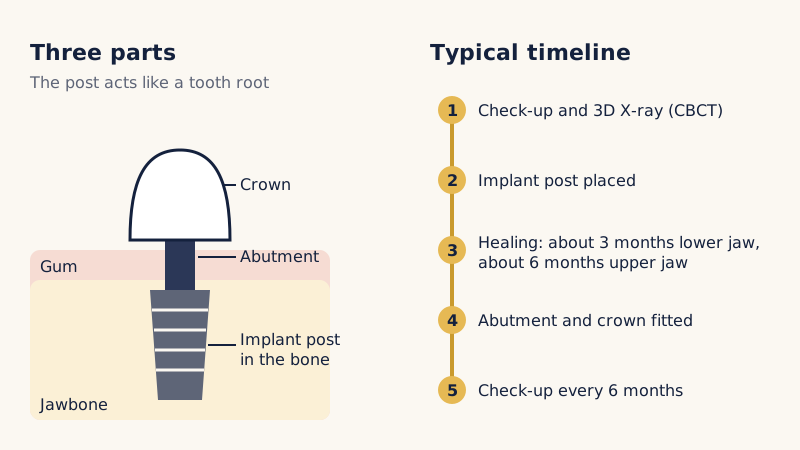
An implant has three parts. The post sits in the jawbone and works like a tooth root. A small connector called an abutment screws into it. The crown, bridge or denture fixes onto the abutment (Cleveland Clinic).
-
Check-up and planning. The dentist examines your mouth and takes a 3D X-ray (CBCT) to measure the bone (Setopati). You get a plan and a cost estimate.
-
Placing the post. The area is numbed with local anaesthetic. The dentist places the post in the bone and closes the gum.
-
Healing. The bone grows around the post. This takes about 3 months in the lower jaw and about 6 months in the upper jaw, sometimes longer (Setopati).
-
Fitting the tooth. The abutment and crown are fitted. This may take one or two visits.
-
Check-ups. A check-up and cleaning every 6 months. An X-ray after the crown is fitted gives a starting point to compare against later (Berglundh et al., 2018).
One missing tooth: one implant post holds one crown (Cleveland Clinic). The teeth on either side are left alone. If the tooth is still there but cannot be saved, it is taken out first (tooth extraction), and the dentist decides when the post can go in.
Several missing teeth in a row: you may not need one implant per tooth. Two or more implants can hold a bridge that replaces three or more teeth (Cleveland Clinic). This means fewer posts and less surgery than one implant for each tooth.
All teeth missing in one jaw: usually 4 to 6 implants hold a full set of teeth (Cleveland Clinic). The set can be fixed in place, or it can be a denture that snaps on and off the implants for cleaning.
What’s included, and what may cost extra
Kathmandu clinics price implants in different ways. Some quote the post and surgery only, with the abutment and crown charged on top. Ask for a written estimate that lists each of these:
| Item | Often in the main price? | Notes |
|---|---|---|
| Check-up and plain X-ray | Sometimes | Needed before any plan |
| 3D X-ray (CBCT) | Often separate | Published at NPR 3,000 to 5,000 (October 2026) |
| Implant post and surgery | Yes | Price changes with the brand |
| Abutment | Sometimes separate | The connector between post and crown |
| Crown | Often separate | Material changes the price, see crowns |
| Bone graft or sinus lift | Separate | Only if the bone is too thin; graft published at NPR 15,000 to 30,000 |
| Removing the old tooth | Separate | See tooth extraction |
| Check-ups and cleaning | Separate | Every 6 months |
How much a dental implant costs in Kathmandu
Published Kathmandu clinic prices for one implant with its crown ranged from NPR 75,000 to 125,000 in October 2026. Premium implant brands were listed at NPR 150,000 to 200,000. Government teaching hospital fees were lower, but the implant itself was often extra.
What changes the price:
- How many implants you need (one tooth, a bridge or a whole jaw).
- The implant brand.
- The crown material (metal-ceramic or zirconia).
- Whether you need a bone graft, sinus lift or a tooth taken out first.
- Whether the case needs a dentist with extra implant training.
| Treatment | Our price (NPR) | Typical visits |
|---|---|---|
| Dental implants | NPR 90,000 to 1,25,000 per tooth, implant and crown | 3 to 5 |
See all our prices on the price list.
Risks, recovery and aftercare
Implants have a good record. A large review found about 96 out of 100 implants were still in place after 10 years, or about 93 out of 100 when people lost to follow-up were counted (Howe et al., 2019). The figure was about 91 out of 100 for people aged 65 and over (Howe et al., 2019). Implants can fail, so no one can promise how long one will last.
The main long-term risk is gum infection around the implant. Early on, the gum bleeds when gently touched. If it goes on, it can eat away the bone that holds the implant (peri-implantitis) (Berglundh et al., 2018). Plaque causes it, so cleaning is the best defence.
Aftercare:
- Brush twice a day and clean around the implant with floss or small between-teeth brushes (NHS).
- Come for a check-up and cleaning every 6 months.
- Stop or cut down smoking, which can disrupt healing (Cleveland Clinic).
- If you have diabetes, keep your blood sugar under control and tell the dentist (NIDCR).
Get urgent care if
- Bleeding from the mouth will not stop.
- Swelling in your mouth or neck makes it hard to breathe, swallow or speak, or your eye swells or your vision changes. Go to a hospital emergency department.
- The implant, abutment or crown feels loose or breaks. Call us or see an emergency dentist.
Source: NHS dental abscess, NHS dental emergencies.
Alternatives to a dental implant
| Option | How it works | Time | Upkeep | Best for |
|---|---|---|---|---|
| Implant | Post in the bone holds a crown | About 3 to 6 months | Daily cleaning, 6-monthly check-ups | Enough bone, wants to leave other teeth alone |
| Bridge | False tooth held by crowns on the teeth either side | Usually 2 or more visits | Clean under it with floss threaders | Neighbouring teeth already need crowns |
| Denture | Removable plate with false teeth | A few weeks | Take out to clean, out at night | Many teeth missing, lower cost, no surgery |
| Leave the gap | Nothing is placed | None | Normal care | A back gap that does not affect chewing |
In one review, a single implant crown and a regular bridge did about as well at 10 years (89.4% and 89.2% still working) (Pjetursson and Lang, 2008). The choice often comes down to your bone, your other teeth and your budget. Compare all the options on the tooth replacement page.
Bringing a parent? Many people book implants for a mother or father. Come together to the first visit so the dentist can explain the plan, the number of visits and the full cost to both of you. See your first visit.
The dentists who do this treatment

Clean and safe
Implant surgery places a device in the bone, so clean instruments matter. Read how we clean and sterilise instruments on our sterilisation and safety page. If you feel nervous, see help for nervous patients.
Sources
- Long-term (10-year) dental implant survival: a systematic review and sensitivity meta-analysis, Journal of Dentistry (Howe, Keys, Richards) (2019)
- Dental implants, Cleveland Clinic (2026)
- Dental treatments, NHS (2026)
- Peri-implant diseases and conditions: consensus report, Journal of Clinical Periodontology (Berglundh et al.) (2018)
- Two-stage dental implant treatment explained by a Kathmandu dentist, Setopati (2025)
- Diabetes and oral health, NIDCR (US NIH) (2024)
- Survival and complication rates of tooth- and implant-supported fixed prostheses, Journal of Oral Rehabilitation (Pjetursson, Lang) (2008)
This page is general information, not a diagnosis. A dentist needs to examine you to know what is right for your teeth.